BEAM: A NEW FRAMEWORK FOR AI AGENT ORCHESTRATION
>>Are Your Bids Losing to Faster Clocks?
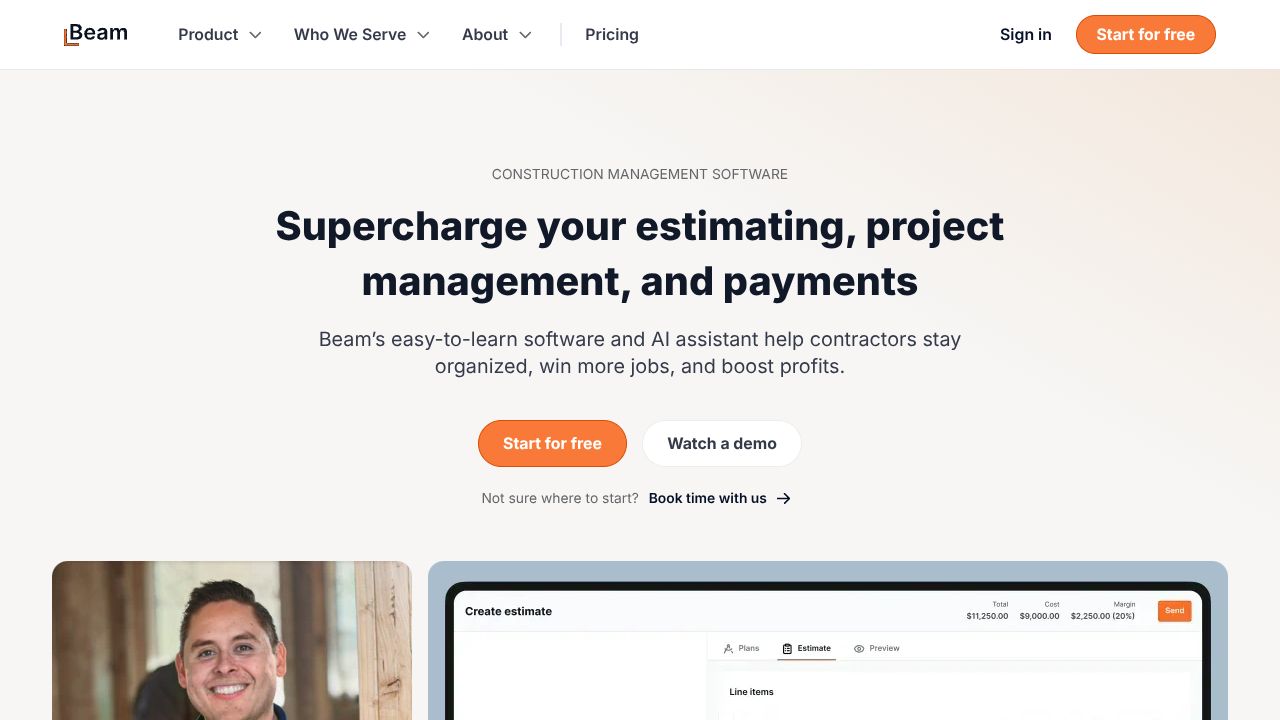
Ever watched a bid slip away because your estimate took 48 hours and the competitor hit “send” before lunch? Beam is a vertical AI estimator that scans uploaded plans or even messy site notes and drafts conceptual estimates in minutes—quantities, costs, the whole first-pass bid. For AI leaders, it’s a proof-point that autonomy wins when it’s pointed at a high-friction, revenue-adjacent workflow. Bottom line: compress bid timelines, reduce guesswork, and lift win rates without adding headcount.
>>The Business Case
Early-stage estimation is a speed game. The team that returns a credible number first usually lands on the shortlist, and the rest fight uphill. Beam attacks that advantage directly—no templating treadmill, no transcription errors from handwritten notes—just plan-in, estimate-out. This is the kind of narrow, outcome-tied automation that earns budget because it moves revenue, not vanity metrics.
If you’re building an AI portfolio, Beam represents a strategic bet on vertical autonomy: a single task with clear inputs (plans/notes) and outputs (quantities/costs) that’s measurable against concrete KPIs. You can track cycle time to bid, estimator hours per bid, hit rate on fast-turn proposals, and variance between AI estimates and awarded costs. Unlike horizontal AI platforms that need months of process mapping, Beam slots into the preconstruction workflow and starts paying back as soon as you can point it at a plan set. Pricing is undisclosed, but the economic logic is simple: if it wins you one more job per quarter—or frees one FTE’s worth of manual takeoff time—it pencils out.
>>Key Strategic Benefits
-
Operational Efficiency: Beam turns plan scanning and takeoff into a minutes-long task, eliminating spreadsheet gymnastics and manual tallying. It integrates with existing builder workflows, so estimators spend time validating exceptions instead of keying line items.
-
Cost Impact: By automating quantity and cost calculations for conceptual bids, you reduce rework and overtime while increasing the volume of qualified bids. More at-bats with consistent first-pass accuracy improves pipeline coverage without ramping payroll.
-
Scalability: Vertical AI like Beam scales linearly with project inflow—feed it more plans, get more estimates—without proportional hiring. It’s ideal for regional rollouts or franchise networks where standardizing early pricing accelerates growth.
-
Risk Factors: Pricing is unknown, so ROI modeling needs conservative assumptions. Also, cost books and local pricing volatility can drift; put a human-in-the-loop to review high-impact items and set guardrails for contingencies and exclusions.
>>Implementation Considerations
Skip the six-month transformation theater. Start with a 30–60 day pilot across one estimating pod or region. Curate a representative sample: residential, light commercial, a few gnarly reno jobs with messy notes. Define ground-truth: past awarded costs and final takeoffs to benchmark Beam’s outputs. Stand up integration points to your cost database and job-costing/ERP so the AI’s numbers map cleanly to your chart of accounts.
Resourcing is light: one precon lead, one data/ops liaison to handle file formats and cost mappings, and an executive sponsor to clear roadblocks. Change management matters more than model tuning—train estimators on when to trust, when to adjust, and how to annotate exceptions so the system learns. My hot take: don’t over-engineer. Beam’s advantage is speed; keep the workflow tight—upload, review, adjust, export—and ratchet complexity only after you’ve locked the basics. Governance-wise, document acceptance criteria, variance thresholds, and escalation paths. The future is autonomous, but autonomy still needs rails.
>>Competitive Landscape
While Origami Agents excels at flexible, loop-heavy sales automations across channels, Beam is better suited for a single vertical job: preconstruction estimating from plans/notes. If you need a programmable agent layer for outreach sequences and CRM nudges, Origami’s your tool; if you need a minutes-fast conceptual estimate, Beam’s the sharper instrument.
Sked Social is an Instagram-first automation platform; brilliant for content ops and Meta optimization, not construction math. It shows how AI can optimize channel-specific workflows, but it won’t replace your estimator.
Creatio offers low-code, enterprise-grade workflow automation and AI inside CRM. If you want to orchestrate approvals, SLAs, and dashboards across departments, Creatio is strong. But building an in-house estimation app there means longer time-to-value. Beam’s differentiation is out-of-the-box, domain-trained estimation speed. Caveat: Creatio may beat Beam on governance features and enterprise licensing clarity; Beam’s pricing is undisclosed.
>>Recommendation
Pilot Beam now. Set success metrics: cycle time to first estimate, estimator hours per bid, variance to awarded cost, and bid win rate on fast-turn responses. Run a 60-day trial with 30–50 mixed projects, human-in-the-loop review, and cost-book alignment. If variance stays within your tolerance and throughput jumps, negotiate enterprise terms and roll out regionally. Keep Origami Agents and Creatio in your stack for adjacent automation, and let Beam own precon speed. Explore: https://www.trybeam.com.