DISCO: A COMPLETE GUIDE FOR ARTIFICIAL INTELLIGENCE PROFESSIONALS
>>From Static Courses to Living Academies: A Hands-On Guide to Disco
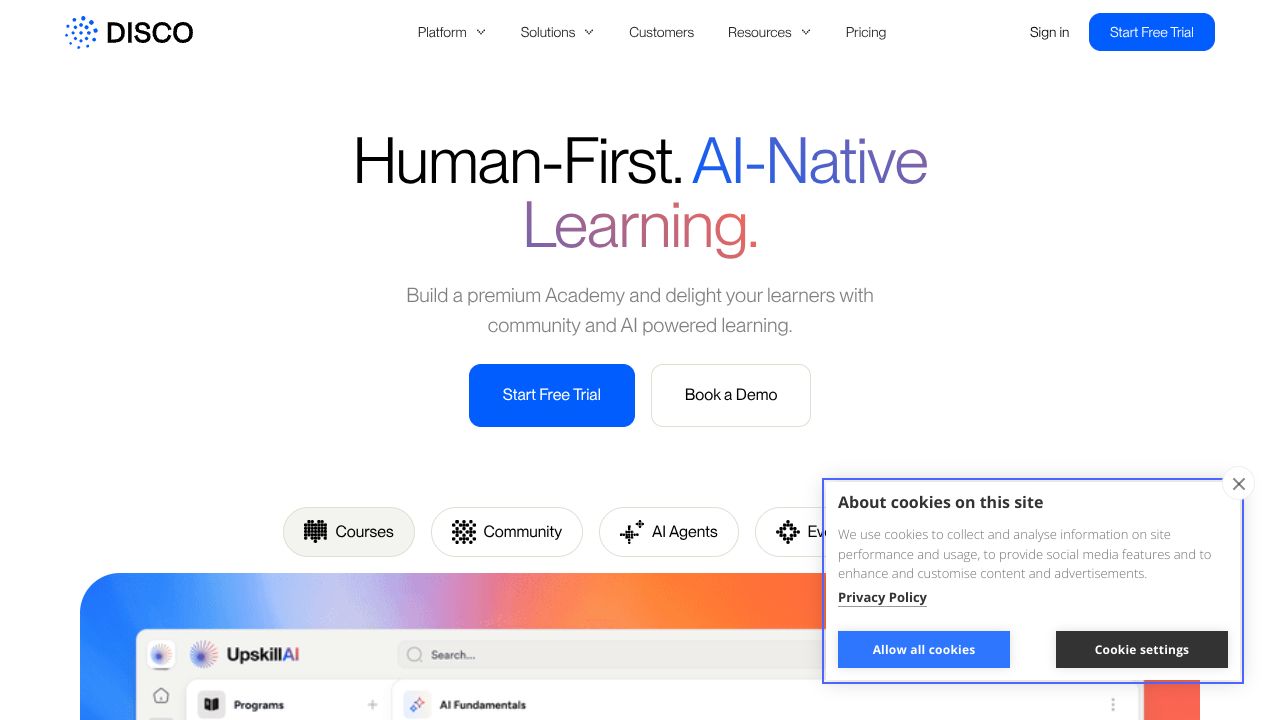
Only 12% of learners finish typical online courses. That stat has haunted me since my early newsroom days—and it’s exactly the problem Disco aims to fix. Instead of dumping videos behind a paywall, Disco combines an AI course builder with social learning and automated operations so your academy actually hums with activity. Think of it as a brandable, AI-enhanced campus, not a lonely LMS. Compared to tools that excel at marketing (Kajabi) or pure community (Circle, Mighty Networks), Disco’s hook is the human-AI synergy: it accelerates course creation while deepening peer-to-peer engagement. My hot take: completion is an outcome of community, not content length.
>>Step 1: Stand Up Your Branded Academy Fast
- Create your account at https://www.disco.co and choose a plan (starts at $79/month). If you’re experimenting, start with one flagship program.
- Brand the academy: logo, colors, tone. I keep a quick “brand kit” doc and paste hex codes in—nothing derails trust faster than off-brand UI.
- Define your audiences: prospects, learners, alumni, mentors. Set up spaces (e.g., “Introductions,” “Weekly Demos,” “Office Hours”) before inviting a single person.
- Use the AI course builder to draft your first course shell. Start with one clear outcome (“Ship a working retrieval-augmented generation demo in 14 days”), not a buffet.
- Import your best existing materials (videos, PDFs, notebooks). Don’t reinvent; refactor. I literally draft my outline on a vintage typewriter, then feed it to the AI for structure.
- Configure access and cadence: cohort dates, self-paced vs. time-bound, and when automation should send nudges.
- Invite a pilot group (10–20 learners). Your goal is signal, not scale.
>>Step 2: Core Features You Need to Know
- AI Course Builder (your accelerator)
- Paste a problem statement and audience. Example prompt: “Build a 4-week course for data scientists transitioning into AI agents. Include labs, peer review, and a capstone deploying a simple tool-using agent.”
- Use the output as a scaffold. I prune aggressively: 60% AI draft, 40% human nuance.
- Community Engagement Tools (the engine of retention)
- Create weekly rituals: “Wins Wednesday,” “Debug Thursday,” “Demo Day.” Tie each ritual to a lightweight post template so it’s dead simple for learners to contribute.
- Seed discussions with specific prompts: “Post your prompt template and one failure case.”
- Automated Operations (the invisible glue)
- Set onboarding sequences: welcome message, how-to video, first assignment.
- Schedule reminders before deadlines and recap posts after live sessions. Automation keeps momentum without you babysitting.
- Branded Academies (trust and cohesion)
- Organize programs, resources, and events under one visual identity. I add a “Start Here” block with a 2-minute loom, syllabus, and code of conduct.
- Social Learning Features (peer pressure, used for good)
- Use peer feedback circles: match learners to review each other’s projects with a simple rubric. Social proof > solo grind.
>>Step 3: Pro Tips for Artificial Intelligence Professionals
- Two-pass building: First pass with the AI builder to map modules; second pass to embed real datasets, notebooks, and model pitfalls (hallucinations, evaluation, cost control).
- Design “Use Case Studios”: weekly deep dives where learners dissect a real deployment (prompting strategy, guardrails, latency budget), then post a one-page teardown.
- Nudge to ship: Automate a mid-cohort checkpoint and a final public demo day. Shipping is the retention lever.
- Constraint prompts for better AI drafts: “Limit to 3 modules. Each module requires one code lab and one peer artifact. Cap total time at 6 hours.”
- Keep a living FAQ: Each time a great Q pops in the community, turn it into a short lesson. Disco’s social layer is your curriculum R&D.
>>Common Mistakes to Avoid
- Over-automation without warmth
- Fix: Pair automations with personal touch points (a quick Loom, a shout-out post). AI scales ops; humans spark belonging.
- Content dump without community design
- Fix: Create 3 repeatable rituals and enforce them. Community isn’t a channel; it’s a cadence.
- Letting the AI outline stand unedited
- Fix: Ruthlessly trim scope. Tie every module to a single job-to-be-done and a visible artifact.
>>How It Compares to Alternatives
- Kajabi: Great for funnels and sales pages; weaker on AI-driven course design and social learning depth. If you sell one-off video courses, it’s fine. For cohorts and community-first learning, Disco shines.
- Teachable: Simple hosting, minimal community. Disco wins when you need engagement mechanics plus automation.
- Circle or Mighty Networks: Excellent communities; lighter on structured, AI-assisted course creation. Use Disco if you want a true academy with outcomes.
- Moodle/TalentLMS: Traditional LMS, strong compliance features, but not built for modern social learning or rapid AI-assisted authoring. Disco is faster from idea to impact.
>>Conclusion: Is Disco Right for You?
If you’re building an AI-forward academy where learners actually finish—and ship—Disco is a strong bet. It marries an AI course builder with community rituals and automation so you spend less time herding cats and more time coaching. At $79/month to start, it’s overkill for a single static course, but a bargain if you run cohorts, peer reviews, and showcases. My read: the future is autonomous, and Disco lets you design for that—human-centered, AI-accelerated, and relentlessly outcome-driven. Now go seed your first “Wins Wednesday” and watch completion follow.