GOTRANSCRIPT VS ALTO SPEECH: THE HONEST COMPARISON
>>Data is the New Oil, but Unstructured Audio is Just Sludge
Raw audio is a liability until it’s searchable, compliant, and structured. GoTranscript bridges the gap between messy human conversation and high-fidelity data, offering a hybrid engine that turns spoken word into business intelligence. For leaders in the AI space, this isn't just about "typing out notes"; it’s about the foundational layer of data integrity that fuels your LLMs and fine-tuning pipelines.
>>The Business Case for High-Fidelity Ground Truth
In our rush toward a fully autonomous future, many leaders forget that "garbage in" leads to "hallucinations out." If you are building proprietary agents or training models on internal meetings, legal depositions, or medical consultations, a 90% accuracy rate from a standard ASR (Automatic Speech Recognition) engine is a failure. Those missing 10% are often the most critical technical terms or nuances.
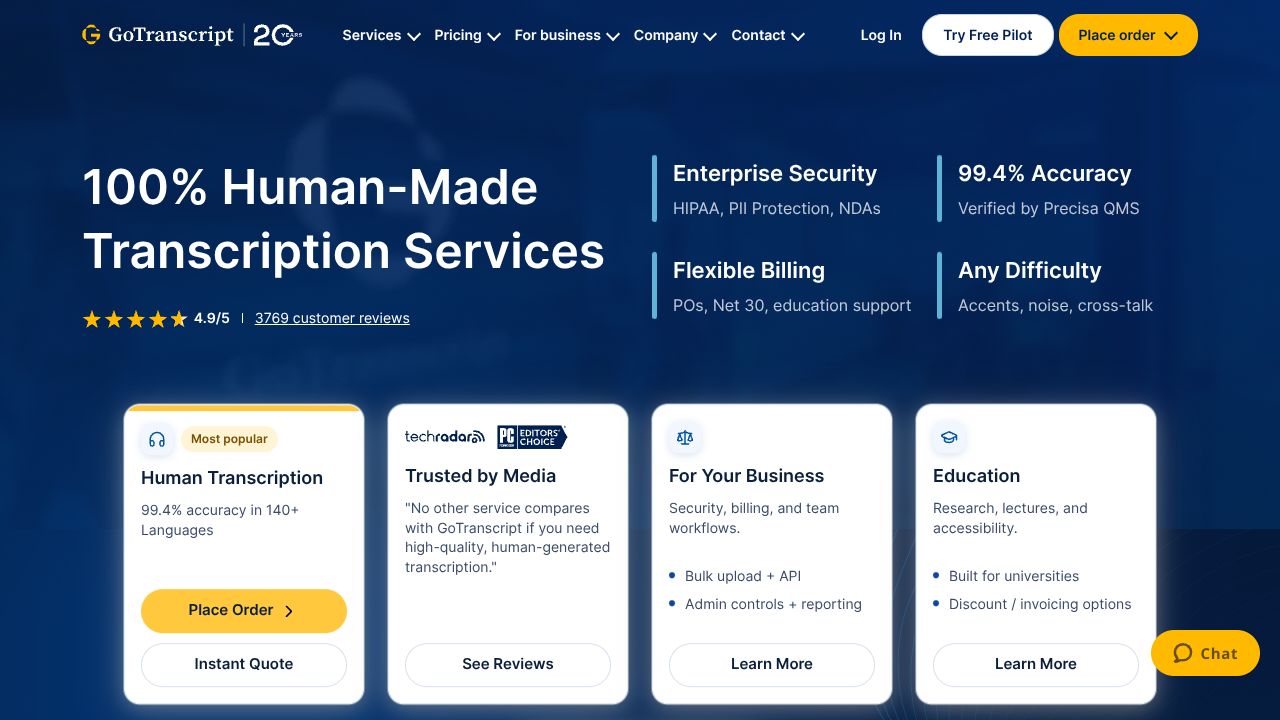
GoTranscript positions itself as the "Ground Truth" layer. By offering a hybrid model that blends AI speed with human verification, they provide a level of precision that pure-play automated tools often miss. While Jotengine is a powerhouse for rapid-fire teleconferencing and call center volume where speed is the primary KPI, GoTranscript is where you turn when the cost of a mistake—legal, medical, or strategic—outweighs the cost of the transcript itself.
From an ROI perspective, the tiered loyalty program (scaling up to 15% off) incentivizes the centralization of transcription assets. Instead of various departments expense-reporting different tools, an enterprise-wide shift to GoTranscript allows for a consolidated, high-accuracy data lake that is ready for RAG (Retrieval-Augmented Generation) applications.
>>Key Strategic Benefits
- Operational Efficiency: By offloading the "cleanup" phase of transcription to GoTranscript’s human editors, your internal data scientists and analysts stop acting as proofreaders. This streamlines the pipeline from raw recording to actionable text, allowing your team to focus on high-level synthesis rather than fixing typos.
- Cost Impact: The pricing model is refreshingly transparent, ranging from $0.20/min for AI-only tasks to $2.34/min for high-priority human intervention. This allows leadership to tier their spending based on the mission-critical nature of the audio, rather than paying a flat "premium" for non-essential files.
- Scalability: With support for multiple languages and a massive network of over 20,000 professional transcribers, GoTranscript handles the "burstiness" of enterprise needs. Whether you have ten hours of audio or ten thousand, the platform scales without requiring you to manage additional headcount or infrastructure.
- Risk Factors: The primary risk is the turnaround time for human-verified scripts, which can take up to five days for the lowest price point. Leaders must ensure they have a clear classification system to decide which files require the human touch and which can be handled by instant AI.
>>Implementation Considerations
Integrating GoTranscript into your workflow isn't just about a one-off upload; it's about building a repeatable data pipeline. I’ve found that the best way to deploy this is to treat it as a pre-processing step for your internal AI agents. You’ll need to define your "Accuracy Thresholds"—determining which projects require the 99%+ accuracy of a human-reviewed transcript versus those that can survive on a "good enough" AI draft.
The platform supports extensive export formats, which is a godsend for dev teams. However, change management is key. Your legal and compliance teams will appreciate the precision, but your fast-moving product teams might find the human turnaround times frustrating if expectations aren't set. Start with a pilot program in a high-stakes department—like Legal or R&D—where the value of accuracy is already understood. I often draft my own "hot takes" on a vintage Smith-Corona, but even I recognize that for enterprise-scale data, you need a digital workflow that doesn't skip a beat.
>>Competitive Landscape
The transcription market is crowded, and choosing the right tool depends entirely on your specific "autonomous" roadmap. For instance, Alto Speech is often the better choice if your primary focus is real-time voice analytics and customer sentiment in a sales environment. They excel at the "live" aspect of the conversation.
On the other hand, TranscribeMe offers a similar hybrid approach to GoTranscript and is a fierce competitor in the translation space. However, GoTranscript tends to win on pricing transparency and its aggressive loyalty discounts for high-volume users. If your needs are more transactional and speed-focused, Jotengine remains a top contender for sheer throughput. GoTranscript’s "sweet spot" is the intersection of specialized domain expertise (legal/medical) and long-term cost-efficiency for large-scale archives.
>>Recommendation
Stop treating transcription as an administrative task and start treating it as data procurement. If your organization handles specialized content where accuracy is non-negotiable, GoTranscript is a strategic necessity.
Next Steps:
- Audit your current transcription spend across departments.
- Identify a high-stakes project (e.g., training a new internal bot) to test the human+AI hybrid model.
- Consolidate volume under a single account to trigger the 15% loyalty discount.